
 |
| HOME ABOUT APHEX CABLES CRYSTAL FREQ CHART SURROUND TEST CD WHITE PAPERS PROJECTS |
|
| Project 300 Stunning Mastering Studio acoustics build, Dynaudio M3's, JL Audio f112's |
|
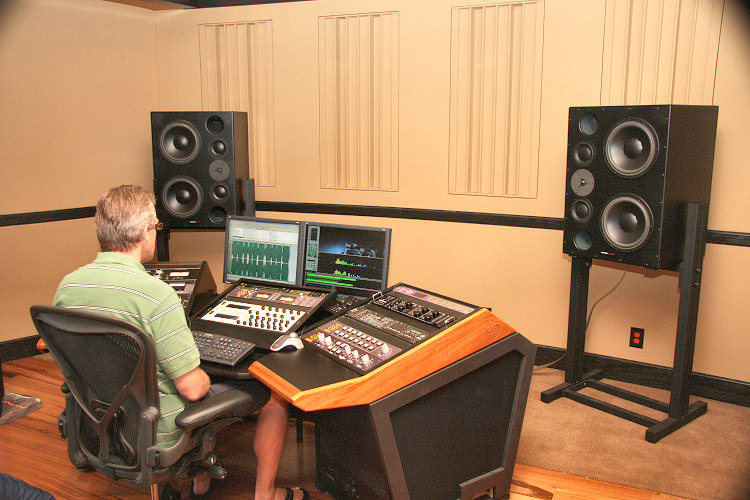
THE CUSTOMER PREMISE We set up a pair of JL Audio f112's (not even 113's !!!) at Fuller Sound, a world famous mastering studio in Ft. Lauderdale. The customer purchased them from his local authorized dealer, Harris Audio Systems. I was hired to fully integrate them. The room is an incredible acoustics and construction job done by John Arthur of Arthur-Lambert. In my 58+ years in audio I can safely say this is, without question THE best overall room I have ever experienced. Floating floor, airlocks, full size bass traps, and the noise floor in the room is 17dB... you simply cannot tell if the A/C is on or off, yet the temperature is perfect and you cannot discern any "wind" or air flow. You can be doing a session in the room at 115+ dB and when you step outside you cannot even tell the building is occupied. All you hear are the crickets and the frogs from a pond 1/2 mile away. Here is the "before": Plain Dynaudio M3's running so-called full range, ports open, no sub. "Okay" -- but not really... |
|
 |
|
| "Before" the Subs were added | |
|
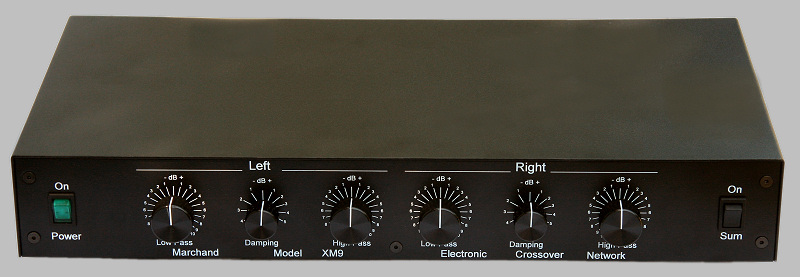
The system is the computers and certain digital /analog mastering devices feeding a Bryston amp into the Dynaudio M3's. Their page is here: https://www.dynaudio.com/professional-audio-discontinued/m-series-passive/m3a (link updated 2018) Mike has been using this system both here and in another location for quite some time. Therefore he was intimately familiar with the EXISTING characteristics of the system, monitoring midfield at about 8 feet. ADDING A CROSSOVER This project was done before the JL Audio CR1 Crossover (which I designed) was even available. So as one of the initial tests, we added a Marchand XM9 crossover (24 dB/octave, 80 Hz) The reason was since it has accurate attenuator click switch positions it could be critically adjusted and returned to any setting accurately. |
|
 |
|
| Marchand XM9 Crossover | |
|
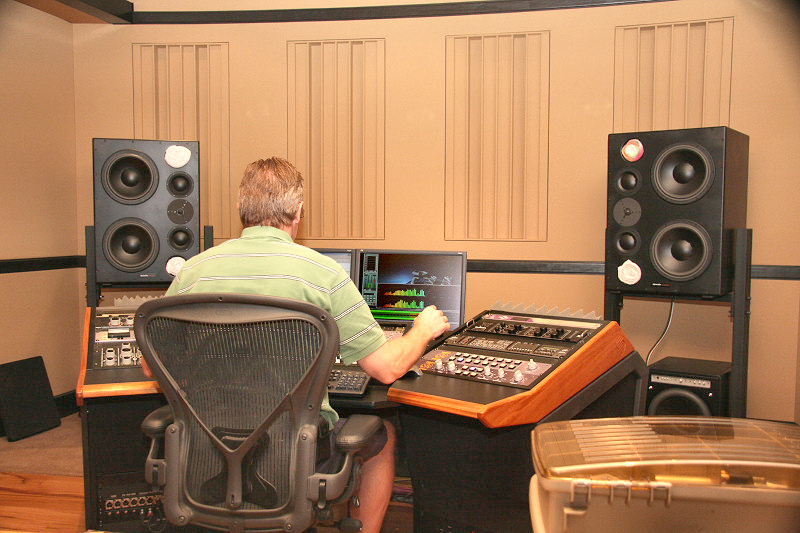
THE FAMOUS "CALIBRATED FT. LAUDERDALE BEACH TOWELS" Here is the initial setup showing the "calibrated Ft. Lauderdale beach towels" we used to seal the ports: |
|
 |
|
| Initial placement of the subs | |
|
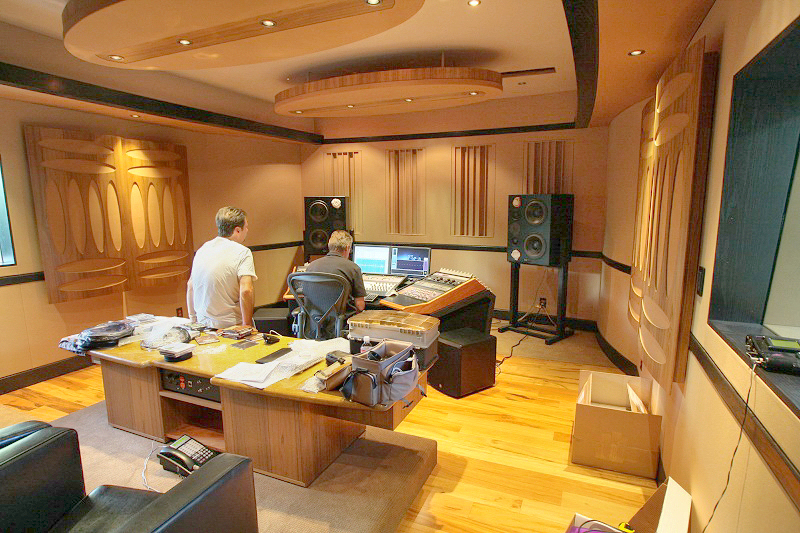
As soon as things were plugged in (it took just a few minutes, but I made a ritual out of it...) it is safe to say everyone's jaw dropped, including mine. The results were spectacular. Of course there was still a bit of fine tuning and experimentation to be done. ABOUT GROUP DELAY Most modern powered subs have a certain amount of inherent group delay, (about 10+ msec) so in order to most accurately (that means fanatically) adjust the absolute phase of the sub to the (relative) phase of the mains at the crossover freq, either the mains must be delayed about 12 msec (which is difficult to do, but more on that later) or the subs should be moved about 12 feet closer to the listener; then the phase control (and polarity switch) on the sub can be used to really fine tune the phase adjustment. In this particular case, after considerable experimentation and some superb room analysis by Don Washburn, The Audio Bug, |
|
 |
|
| Front view of the room and the subs in their final position at the front edge of the desk | |
|
Once the subs were moved into position I adjusted the phase using my TEST CD. (here: soundoctor.com/testcd ) When you play the 80 Hz tone (which comes through one channel only) since the crossover sends that to the sub as well, the 80 Hz comes out of both the mains and the sub at essentially the same level. You then reverse the wiring to the main speaker. Now the "mains" and the "sub" are purposefully out of polarity. You then carefully adjust the polarity switch and the phase control on the sub until you hear the null. It's clean and sharp ! Then you put the wiring back on the main and you're all set. Then do the same thing to the other channel. THE WIN-WIN SITUATION The net result of all this is astonishing -- everything about the setup is a win-win situation: a) since you are now NOT putting in 20 Hz - 80 Hz into the mains you are not using up the LF cone movement with bass, so the LF cone is able to play its higher freqs (up to IT'S crossover point) much more cleanly. You get an apparent 6dB more dynamic range. b) since you are not putting bass into that same driver you are not Doppler modulating everything between 80 and 600, or whatever the next crossover point is. This means cleaner mids. By far. c) you are not sucking current out of your main power amp, so there is more current reserve to play those highs louder... d) since the cones aren't moving as far at the low freqs the driver itself is not generating as much back EMF therefore the damping factor and all of its issues are greatly negated. e) freqs below 80 are now NOT causing transient intermodulation distortion with the higher freqs (and vice versa). Cleaner still. f) whatever speaker cable you are now using likes it better, since there is much less Low Freq current going to the mains. I should point out that these are v1 F112's and the JL Audio ARO in this version sub has one band of pull-down EQ. HOWEVER - and this is very important - because the room acoustics is SO GOOD, the ARO function was completely unnecessary. You can do Ethan Winers' test of playing a sine wave and walking across the room right in front of your main chair from completely left to completely right, and in MOST INSTANCES you will get a null or more than one null that might be 10-40 dB down - a real "black hole". In this room there is only a variation of about 1 dB or so, anywhere in the area. Stunning! This is completely because of the correct physical room acoustics and construction. The whole end result speaks of all those lovely adjectives that magazine writers love to bandy about: the imaging is palpable, holographic, with the correct warmth AND HEIGHT (this was one of the first things I noticed) ; you get the sense you can look behind the layers for example look "behind" the lead female vocalist and detect the band "behind" her. It's uncanny and reads like all those superlatives that the magazine writers use when they are astounded. All of this is a direct result of IMPULSE RESPONSE, the holy grail of audio. People have been taught to think (or not taught to think otherwise) about frequency response when in fact frequency response is the LEAST important issue; phase response and certainly impulse response are to be considered first. Under the mathematical umbrella of impulse response IS CONTAINED both phase response and frequency response. Imagine for a moment a great recording of a kick drum. (That in itself is a fantasy, but more on that later) If you play this back on a relatively poor system, yes, your brain knows it's a kick drum; you intellectually 'know' it's a kick drum, i.e. "I'm playing a rock n roll song and I expect a kick drum there..." but the first time you are almost frightened into thinking someone has actually placed a kick drum IN your living room and is playing it, it's a revelation. A kick drum has a fundamental around 50-60 Hz, and also a SUB-harmonic an octave lower, which makes it about 25-30 Hz. Since it is an IMPULSE signal, it essentially has an odd harmonic train that extends quite high (theoretically infinitely...) but in our case I'll suggest at least to 4 or 5 kHz. That means that in order to CORRECTLY reproduce this kick drum hit, which is a positive pressure wave leaving your speaker cones and traveling toward your body, ALL the drivers in your system MUST be perfectly aligned in TIME (that means phase). If the drivers are OUT of time (for example the sub is 8.5 msec late) you will psychologically still know this is a kick drum hit but chances are you won't have that magic feeling that there's actually a kick drum IN THE ROOM with you. So we can extrapolate this cleanliness of impulse response through the entire system. At LOW freqs, this is mainly a function of the subwoofer tied into the main system and how well it's matched up; it should have the same (but opposite) slope in both the frequency and phase domain, which is why we use a 24 dB/octave Linkwitz-Riley crossover. The acoustic summing of these wavefronts, from both the mains and the subs, therefore results in flat response in both the frequency and phase domains at the listening position -- which we can call the sweet spot. It is also possible to get a great result in one domain with poor or atrocious results in another domain. All too often, people may adjust a system for whatever they consider to be reasonable or correct frequency response while completely ignoring phase response. And each of these issues is a multi-edged sword: the response may be different in either domain off vs on axis of the speakers... and so on. And the problem is slightly different still when discussing different SIZED rooms or venues, where there are differing standing wave issues, and differing room modes. ...to read on about all the technical reasons for all of this, go to my SUBS white paper. |
|
|||
 |
|||
| There is no plug-in for experience... | |||
|
|||
 |
|||
| SOUNDOCTOR BARRY OBER EMAIL: barry@soundoctor.com | |||
|