|
Aphex, and the Aural Exciter"
A LITTLE HISTORY
The Aphex company in general and their Aural Exciter (or on their new website, now just called just the EXCITER, HERE) are virtually unknown in the Home Stereo / Home Theater world. Very successful in the Broadcast / Recording Studio / Professional / Live Sound Venue / Club Installation markets for 40+ years, it can be safely said that essentially any of the music you hear on your radio or a CD or download from some website has at some point in its life passed through an Aphex device, (they make many other things) whether it be a superb microphone preamp or compressor, or limiter, or Aural Exciter or gate, or one of their exemplary guitar / bass foot pedals.
In the Los Angeles recording studios, the early units were rented (by the minute!) and it was considered a "secret" to getting a sound that was just a little more magic than the "other guy" could get, and by word of mouth, the studio use of their devices spread like underground wildfire in the 70's and 80's. The first "big" album to use the Aural Exciter was Fleetwood Mac, Rumors.
In the mid 80's, telephone talk shows were the up and coming rage in AM radio. I had the opportunity to set up a rather fancy station in Miami. Of course the station management and producers were always looking for some sort of "edge" to their sound, to make it "louder", "hotter", "better" and so on, (and we could hope more tasteful, but nah...) I brought in an Aural Exciter processor and hooked it up to the telephone audio feed, and the result was the incoming telephone line almost sounded better than the host's $1000 microphone! So we put a 2nd unit on the host's voice! The producers of that show and the radio station management were stunned at how their new-found clarity made their station "jump out" on the radio dial it made AM sound like FM and everyone was thrilled.
Here's a recent article with a nice history: www.musictech.net/2014/06/aphex-aural-exciter/
WHAT IT DOES
This same technology is available to be connected to any home theater or 2-channel stereo system, and it will amaze you. It is affordable and rather easy to use it puts the FUN back into audio. Remember when you were a teenager and the latest song came out on the radio an you sat glued to the (probably not very good) speaker, enthralled with the sound and at the same time wishing it could sound even "better"? How it could have more bass, have cleaner and crisper highs, be louder, punchier, and so on... and, "wouldn't it be nice if..."
Here's another example. Let's say you have a pretty nice 2-channel "stereo", with pristine components and you think you are hearing everything that's "there". Well maybe...especially if you still have a high-end analog turntable/phono setup. But because of the limitations of the CD technology, if you play CD's you are missing what can only be described as the "air" in the recordings. But you don't KNOW that, because you have never heard it any differently! You have nothing to compare that's any better!
Please understand: the Aphex is NOT an equalizer. (besides, equalizers don't make things 'equal' but that is the topic for a large book, not this article...) It is a dynamic, realtime processor, with separate sections that operate in the low frequency area of the spectrum (the "Big Bottom" part) and a section that operates in the high frequency part of the spectrum (the "Aural Exciter" part). You will, for example, be able to make cardboard drums from mediocre rock n roll recordings sound much more alive and punchy; you will be able to hear "way into" the mix as you have never heard before; vocals will have a more intimate presence, and you may even hear subtle things you had NO IDEA were there. Serious classical students comment that for the first time they truly hear the "wood" of the cello and violins as if it were right in front of them, and they also always ask why this audio information "gets lost" in the recording process...
I used to have a model of the Aphex 204 set up in my high end store. Every time (without exception) that people came in and brought a CD with them I would say "watch my fingers and listen" as I pushed in the buttons on the 204, and when they heard the difference their jaws would drop.
I had arranged for a unit to be sent to the nice people at Secrets of Home Theater and High Fidelity. Colin Miller has written an amazing and complex review which you may read HERE.
I'll cut to the chase. You can make an astonishing difference in your system, especially when playing older CD's and rock n roll and it will add a magic quality of air and ambience to dull classical recordings that will stun you. Part of the enjoyment in this device is that IT AFFORDABLY RECONNECTS YOU TO THE PROCESS OF ENJOYING THE MUSIC. You now have:
a) various knobs to turn,
-and-
b) they actually do something you can hear!
Yes, you may leave the settings alone at some nice position, but being involved with music YOU THINK YOU KNOW and hearing it in what seems like a totally fresh and exciting new way is a large part of the magic.
HOW TO CONNECT
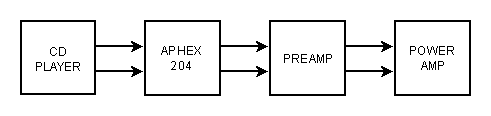
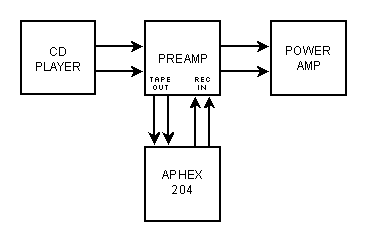
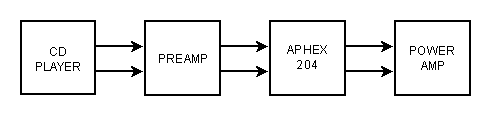
With a 2-channel system you can put one unit (2 channels) essentially anywhere in the chain: either in the tape loop, between the "preamp out" and "power amp line in", or even in the analog path at the line outs of the CD player. If your preamp has a tape loop function then that is the easiest place. Since the unit has both unbalanced AND balanced connections it can be wired to anything.
|


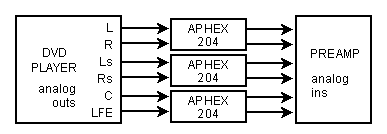
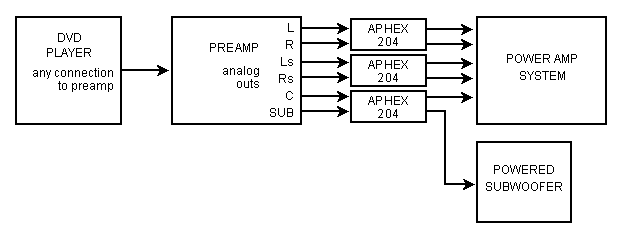

 1.3mb
1.3mb